

Written By: Ariadna Campbell
The word “catholic” is often mistakenly associated, mostly by the secular world, with people who cling to narrow-minded views and outdated traditions. However, according to the Merriam-Webster’s Dictionary, “catholic” actually means “Comprehensive or universal. Broad in sympathies, tastes, or interests.” A truly catholic perspective is, therefore, not a narrow minded one, but well-rounded. In the best sense of both meanings, Mr. Laurence Brodeur, through the wealth of his experiences, possesses a catholic perspective.
Brodeur was welcomed to PA this year as the new American History teacher. His odyssey to this school in Minnesota is an interesting one; and, as with most stories, it is best to start from the beginning.
Born and raised in Montreal, Canada, Brodeur was an only child in a French-speaking home. He’s always considered himself a nerd. Mr. Laurence Brodeur, American History Teacher
He gleefully admitted, “I’m curious by nature, and I’m a bit of a bookworm. I own my geekiness. It’s my flag, I suppose.”
At 13, he developed an interest in history. This interest was sparked by watching “Indiana Jones,” the famous Spielberg film about the adventures of an archaeologist. And once the flame ignited, it never faltered; he enthusiastically went on to get a BA in history at the College of Montreal and a PhD in French history from the University of Toronto. For his doctorate (which involved the French colonies), he spent a year studying relevant archival documents in French libraries and universities.
Brodeur travelled to Russia in 2000 for a summer program at the Smolny University of Kiev. One day, while at the Tretyakov Gallery in Moscow, he stumbled upon the icon “Our Lady of Kiev”. Without hesitation, he converted to Catholicism.
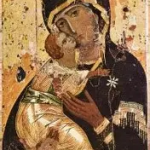
Our Lady of Kiev
After completing his doctorate, Brodeur lived in St. Paul for eight years and taught at Saint Paul Central High School. During his last two years, he was a professor at St. Thomas College. He then relocated to North Dakota for several years; while there, he taught at the University of Mary and also taught fifth grade at a Catholic school. In 2024, he returned to Minnesota and was drawn to teaching at PA because of the positive impression that PA alumni gave him while at the University of Mary.
Brodeur was exposed to an array of cultures along his journey here. By living in two different countries aside from America, he has rare insight into the American identity. He appreciates the ambition of the American public—their instinct to actualize the American Dream without relying on the government for answers. When asked to compare and contrast America with Canada, he emphasized the independence of Americans.
“There’s a belief here that things will work out without having to wait for somebody to tell you. In Canada they would say, ‘Let’s go to the government for a solution.’ Here, we say, ‘How can we make life good for ourselves?’. We know what’s good for ourselves and we know what we need. The government can assist us, but it’s not about the government providing solutions—it’s about us making it happen.”
Brodeur fosters a patriotism brimming with American vigor.
“And we have made things happen,” nodding towards the Declaration of Independence on his wall, “because we know what’s good for us as human beings: life, liberty, and the pursuit of happiness. We don’t need the government to tell us how to be happy, and people understand that here.”
He further compared the American attitude towards religion with attitudes prevalent in France.
“In France, they cannot figure out happiness. Here, religion plays a part in who you are. Over there, it’s much different; the human person is not seen in the same way. Here, your faith is very much a part of who you are.”
Brodeur’s experience, his catholic perspective, allows him to draw conclusions about different cultures—cultures not only across countries, but also within the boundaries of Minnesota. He has been exposed to both public and private schools, and he openly admits how stark the contrast is between the two.
Brodeur beamed, “Here, it’s like a dream…The mission is what got me here. [At the public school where I taught], you don’t have a mission; there’s no faith, knowledge and virtue. But here, you have a sense of direction, a sense of purpose—that is what I want to be a part of.”
Though Brodeur has only been at Providence for about a month, he already has a definite feel for what the student body emulates: “Fides, Virtus, Scientia.”
“People really want to be good—morally, spiritually, academically, and intellectually. That’s how I see the student body on the whole…So if you ask me, that’s the difference between public [schools] and this place,” he continued.
Brodeur knows what it means to be catholic, with and without the religious connotation. He’s been immersed into secular countries and microsocieties and has extracted the consequences of both. Because of his catholic perspective, he is infused with passion for America and Catholicism and seeks to transmit that vigor into his students.
“Life, liberty and the pursuit of happiness. It’s in the Constitution. It’s the law of the land for a reason, and we are trying to live up to it, even though we are human beings and we fail at things. But it’s a noble pursuit. The American experiment is something that’s never been done before in human history, and we’re trying to uphold those ideals, and it’s on us to work on ourselves to make that happen. I came into it; I didn’t grow up here. So I had to think about it—what it means to be an American. And that’s my journey. It’s a journey that everyone has, asking that question. People are going to sit down at the dinner table and ask their parents, ‘What does it mean to be an American?’ And then, eventually they will be asked that question by their own kids. My job is to make sure that they have an answer for their kids. Life, liberty, and the pursuit of happiness is an idea that I love,” Brodeur concluded.
Anyone who encounters Mr. Brodeur will have no doubt that he will succeed in communicating the essence of American identity to his students. His catholic outlook is wise, and his vibrant and unapologetic American spirit is to be admired and emulated.